People Don't Vote Their Beliefs Anymore. They Vote Their Team.
Something has shifted in how Americans treat people on the other side of the political divide, and it's worth sitting with the numbers for a moment because they're genuinely strange. In the 1960s, roughly 5% of people said they'd be unhappy if their child married someone from the opposing party. Today that number sits somewhere between a third and a half, depending on the survey. People increasingly say they wouldn't want to live next door to someone who votes the other way, wouldn't want to be friends with one, and rate the other side's voters as less intelligent, less trustworthy, and more dangerous than they used to.
What makes this strange is that it isn't really about policy. Americans haven't grown dramatically further apart on taxes, healthcare, or immigration over the same sixty years. Plenty of research finds the public's actual policy views have stayed fairly stable or moved in ways too small to explain feelings this intense. What's changed isn't the substance of disagreement. It's the emotional temperature surrounding it. Researchers call this affective polarization, and the word "affective" is doing the real work in that name. This isn't a story about ideas clashing, it's a story about feeling; specifically, contempt.
A group of political scientists went further and gave this contempt a more precise anatomy. They call it political sectarianism, and they argue it runs on three distinct psychological currents that tend to travel together.
The first is moralization: seeing your own side's values as righteous and the other side's as not merely mistaken, but corrupt. This is a step beyond ordinary disagreement. You can think someone's tax policy is wrong without thinking they're a bad person for holding it. Moralization collapses that distance, turning political disagreement into a referendum on someone's character.
The second is othering: coming to see the opposing side as fundamentally different from your own. Not just people who happen to disagree, but a different kind of person altogether. This is where some of the most striking findings in this literature come from. Ask Democrats to estimate what share of Republicans earn over $250,000 a year, and they'll guess something like 38%; the real number is closer to 2%. Ask Republicans what share of Democrats are LGBTQ, and they'll guess around 32%, when the real figure is roughly 6%. Neither side is making an honest mistake. Once you've othered a group, you stop seeing them accurately. You see a caricature built to justify the distance. While getting the statistics wrong may not be a serious problem in an of itself, the real issue with othering is that once you see another group as “less than” then it is easy to justify things like stripping away their rights or justifying the use of violence against them.
The third is aversion: a simple, growing desire to avoid the other side altogether. Not persuade them, not argue with them, just not be around them. Live somewhere else. Work somewhere else. Date someone else. And we are seeing some evidence, particularly in workplaces, of partisan sorting whereby firms are becoming increasingly politically homogenous.
Here's the part that matters most for understanding why this has become so consequential: these three currents don't require much genuine attachment to your own side to sustain themselves. You don't need to feel proud of your party, energized by its ideas, or connected to its people. You just need to dislike the other side enough. Researchers have found that hostility toward an opposing group can anchor a political identity almost entirely on its own. This inverts something political psychologists used to take for granted, which is that people are drawn toward groups mainly by what they love about them, and only secondarily come to dislike whoever's on the outside. Under affective polarization, the arrow points the other way. The animus comes first, and the identity organizes around it.
There's a second thing that makes today's political identity behave differently from the group identities people have always had (e.g., the tribe of your job, your alma mater, or your gender). It used to be the case that political identity was one loyalty among many, relevant in some contexts and irrelevant in most others. That's no longer true for many. Political identity today aligns closely with race, religion, geography, and class, in a way it didn't a few decades ago. And that alignment means the different pieces of a person's identity increasingly move together rather than staying independent. Political scientists call this a mega-identity, and its defining feature is that activating one part of it tends to activate all the others. Bring up a fairly ordinary workplace topic — a diversity initiative, a hiring decision, a benefits policy — and there's a chance it will detonate along partisan lines. Not because it's inherently political, but because it happens to touch an identity that partisan feeling has attached itself to. Think about the partisan reaction Cracker Barrel faced from merely wanting to change its signage. Maybe it was a bad idea, but was it a sign the firm had “gone woke”?
Put all this together, and you get a phenomenon that behaves nothing like a policy disagreement and, honestly, not quite like older forms of group rivalry either. It's contempt for an out-group, sustained without much need for love of the in-group, wired into identities far beyond politics, distorting how each side perceives the other. And none of this stays contained to politics. It follows people into their workplaces, into what they choose to buy, and into how they judge the organizations they work for.
Belief Isn't Driving the Bus
Most research on politics — and most people's own intuitions about it — still works from an older model of how political behavior works. In that model, behavior flows from belief. People have a coherent set of values, and their political choices follow from those values in a predictable way.
The problem is that this isn't how people behave. Not now and not in the past. Studies find that people’s stated political beliefs are surprisingly unstable. Notably, they shift to match whatever their party currently believes, rather than the other way around. When a political party changes its position on an issue, its supporters tend to follow, sometimes reversing themselves within months. For example, Republican voters have historically supported free trade; when the party's leadership pivoted toward tariffs, rank-and-file Republicans pivoted with it. In one memorable study, researchers showed people an identical liberal policy position and told half of them it came from a generic source and told the other half it came from Donald Trump. Republicans who'd been told it was Trump's position became significantly more likely to support it despite the policy itself being one their party had long opposed.
COVID-19 is perhaps the starkest example. Decades of psychological research had established that conservatives tend to be more risk-averse than liberals, and more attuned to threats — including, specifically, the threat of disease. If political behavior really worked the way the old belief-driven model assumes, that research would have predicted something clear: when a genuine, unfamiliar pathogen showed up, conservatives should have been more alarmed than liberals, not less. Disease threat was exactly the kind of thing conservative psychology was supposed to be wired to take seriously.
The opposite happened. Conservatives, and Republicans specifically, ended up less worried about COVID-19. That's a genuine inversion of what the standard psychological account would have predicted, and the reason for it wasn't some deeper truth about conservative psychology reasserting itself. It was that Republican elites and conservative media, almost from the moment the virus appeared, consistently downplayed its threat. And rank-and-file Republicans followed their lead, adjusting their sense of the danger to match what their side's leaders and media were telling them, not the other way around. (There’s a reasonable argument to be had that conservative ideology ran afoul of the measures to try to deal with the disease. But not the existence and the threat of the disease itself).
This is the pattern showing up again and again: belief didn't drive behavior. Identity and loyalty did, and belief followed along behind, reshaping itself to fit. A trait that should have made conservatives more cautious about a genuine disease threat got overridden by something stronger — the pull to stay aligned with what your side is saying, regardless of what a detached read of the threat itself would suggest.
Why "Just Give Them the Facts" Doesn't Work
The old, belief-driven model assumes something specific about how people process information. When you give someone new facts, they update their view accordingly. That's the whole logic behind fact-checking campaigns, crisis communications, and most efforts to defuse a public controversy. The assumption behind these strategies is that a clearer explanation or better evidence will move people toward a more accurate, calmer position.
Affective polarization breaks that assumption in a specific, well-documented way. When someone's political identity gets activated — by a news story, a public controversy, a coworker's comment — their mind doesn't process what comes next neutrally. Attention narrows toward information that confirms what they already believe. Evidence that challenges their own side gets picked apart, scrutinized, explained away. Evidence that challenges the other side gets waved through without much scrutiny at all. And critically, if you give someone counterevidence in this state, instead of updating their view, they often become more confident in their original position, not less. Psychologists call this motivated reasoning, and it means that "just give them the facts" can be exactly the wrong move once a political identity is switched on. The intervention doesn't fail to help. It can actively backfire, hardening the very position it was meant to soften.
This has a second layer that makes it even more far-reaching. Political identity, remember, has become a mega-identity that is wired into race, religion, gender, class, and geography, and capable of activating in response to almost anything that touches one of those connected identities. That means identity-protective reasoning isn't limited to obviously political moments. It can switch on during a hiring decision, a discussion of workplace benefits, or a debate about what values an organization should publicly stand for because so much is now tied to the same underlying identity that almost any of these moments can trigger it.
There's a third piece, and it's easy to miss because it's not about what happens inside any one person's head. A lot of what drives political behavior isn't really individual at all. It's relational. Whom someone trusts, whose version of events they believe, and how they react to a controversy are heavily shaped by their social network: who they talk to, whose opinions they've absorbed, which media environment they're embedded in. Sociologists who study social networks have long argued that people aren't best understood as isolated individuals carrying around a fixed set of beliefs. Rather, they're nodes in an ongoing web of relationships that shapes what they think is true and who they trust to tell them. Applied here, that means affective polarization isn't just something that happens inside individual minds. It's something that gets produced and sustained between people; often amplified by political figures and media outlets who benefit from keeping partisan identities activated and reinforced through the everyday social act of talking to people who already agree with you, which happens to feel good and confirms what you already believed.
Put these three pieces together — identity-protective reasoning, a mega-identity that can be triggered almost anywhere, and a relational engine that keeps the whole thing running — and you get a very different picture of how political conflict unfolds than the one most people, and most organizations, are operating from. It isn't a set of isolated disagreements waiting to be resolved with better information. It's a self-sustaining dynamic, running on identity and emotion rather than facts, that can flare up in places that have nothing to do with politics on their face.
What This Does to Companies
It's tempting for a company to think of all this as something happening out there, in the country, while the firm goes about its business. It doesn't work that way. Affective polarization reaches a firm through three doors: the political and regulatory world it operates in, the customers, investors, and partners it does business with, and the people who work there. At each door it can create both risk and opportunity (Figure 1).
Start with government. Firms aligned with the party in power can benefit, for example, with contracting preferences, lighter regulation, exemptions. One watchdog report claims the Trump administration dropped enforcement actions against 104 technology firms that had collectively spent $1.2 billion supporting Trump and other Republican candidates in the 2024 election. The flip side is what happens when power changes hands. California's Democratic governor canceled a state contract with Walgreens after the pharmacy chain heeded a warning from Republican attorneys general about dispensing abortion medication in their states. And because moralization turns compromise into betrayal, politicians in a polarized system have little reason to work across the aisle, which means more gridlock and a growing expectation that companies will step in to solve the problems government leaves behind.
Then there are the people a company sells to and answers to. Consumers lean toward companies that share their politics, and some firms — Patriot Mobile on the right, Blue State Coffee on the left — are built around it. But the risk is lopsided, which follows from the point about contempt coming first. In one study, customer visits to major retailers fell after their CEOs backed expanding background checks for gun purchases. The drop was larger in conservative counties, and there was no offsetting bump in liberal ones. Dislike is a stronger force than affection, so taking a side tends to cost more than it earns. Risk travels through partnerships, too. When Bud Light faced backlash over a partnership with a transgender influencer, many of its parent company's distributors were hurt by the sales decline. Investors aren't neutral either. Partisan leanings show up in analyst ratings, loan pricing, and shareholder activism.
Inside the firm, the picture is just as mixed. Companies are becoming more politically homogeneous, partly because workers prefer colleagues who share their politics. Some will even accept lower pay to work for an employer who shares their partisan affiliation. That can mean easier recruiting and less friction. But it can also mean that a firm aligned with one party struggles to attract the young, college-educated workers who increasingly identify with the other, loses diversity along other dimensions because political identity is bundled with them, and gets pushed by a like-minded workforce into public stands that alienate outsiders. Early evidence also suggests that politically balanced firms may innovate less, which the researcher attributes to animosity and reduced collaboration, though that finding is preliminary. And for leaders, mishandling a politicized issue can be personally costly: the backlash over Target's retreat from DEI reportedly contributed, at least in part, to its CEO's departure.
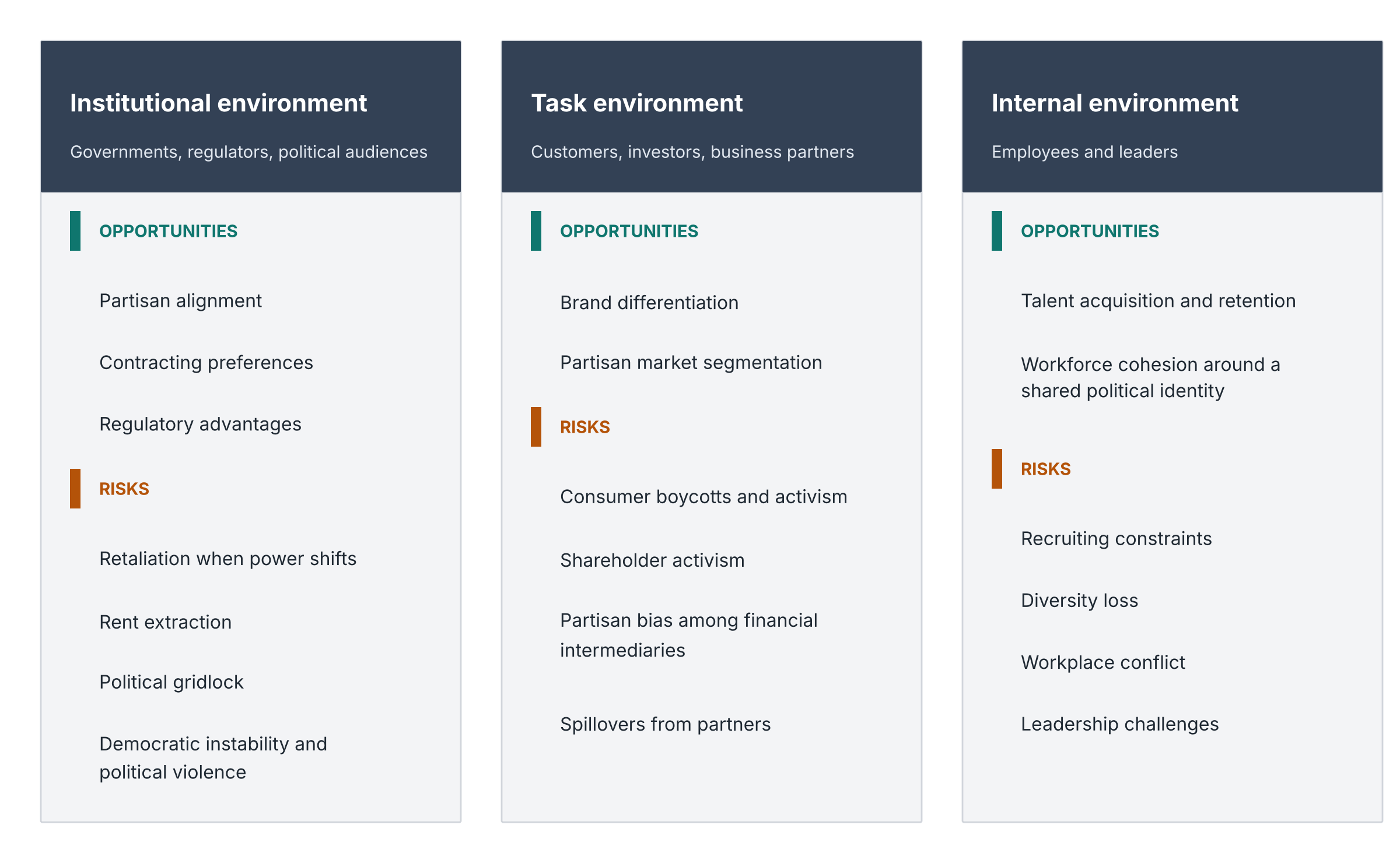
Opportunities and risks across firm channels
Who Gets Hit Hardest
Not every company is equally exposed. The argument is that exposure comes down to how visible a firm is to partisan audiences and how tangled it is in politically charged relationships. Reliance on government is the clearest driver: companies that depend on political giving, face heavy regulation, or sell to government. Several Republican-led states, for instance, pulled money from BlackRock over its perceived leadership on ESG investing. Beyond that, four traits raise a firm's profile: selling directly to individual consumers; being large, which brings more media attention, more activist targets, and more politically varied stakeholders; operating in many places rather than one; and being older and more established. Younger firms get a pass on visibility, but they also have something established companies don't: the freedom to choose a political identity before one gets assigned to them. Figure 2 shows which traits matter through which door.
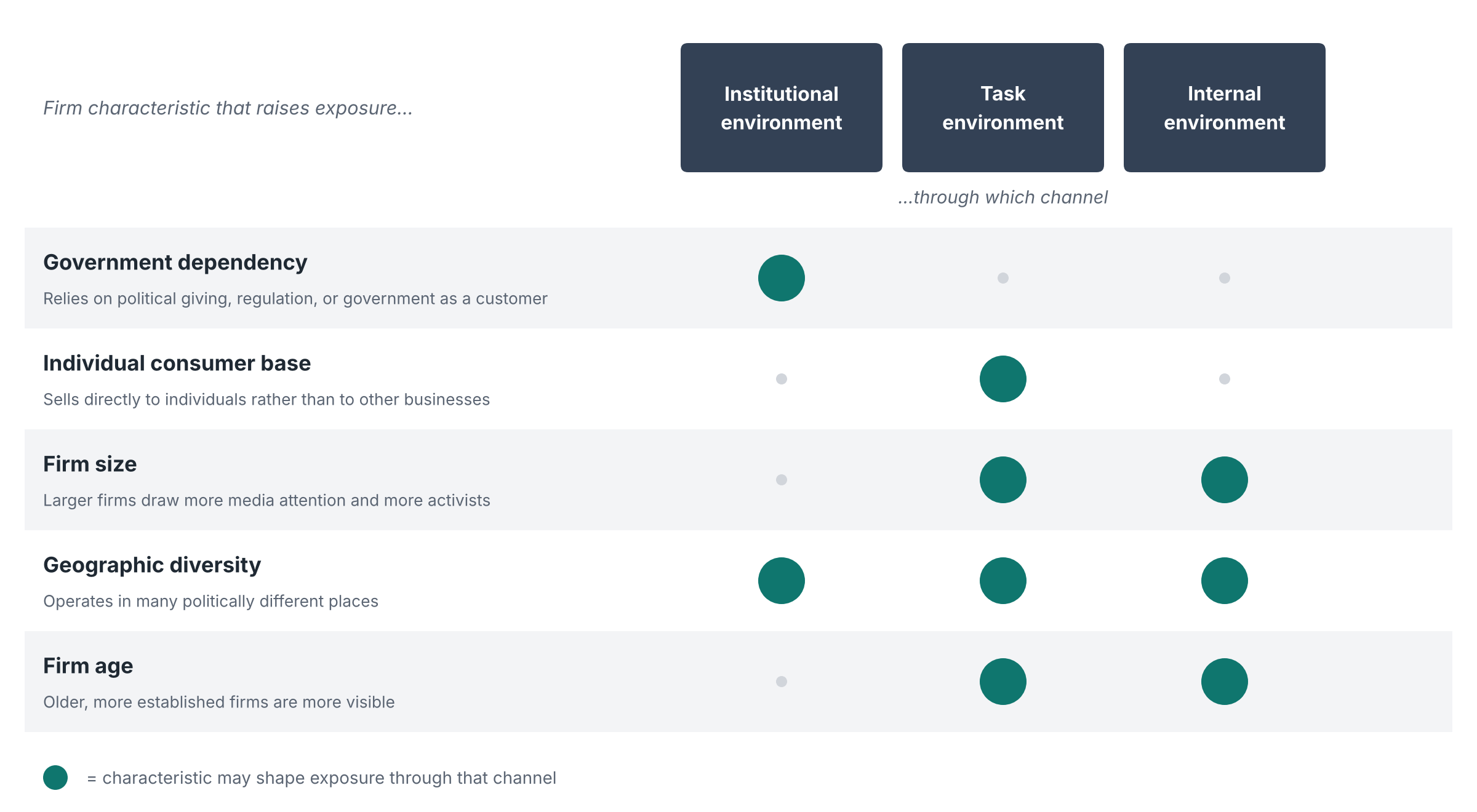
Firm exposure to affective polarization
What a Firm Can Actually Do
Suppression means staying out: no visible political giving, no stands on politicized issues, no relationships with partisan organizations, and no politics at work. It works best for firms that aren't very visible and have few risky ties. But it has a catch that follows from the totalizing nature of political identity. When Coinbase tried to stay politically neutral, the move was perceived as implicit side-taking, and roughly five percent of its workforce left.
Balancing starts from the recognition that the effects are too pervasive to avoid, so the goal is to manage them: weighing the political risks of partnerships and public stands, and favoring access-seeking, cross-party political activity over partisan giving. Internally, the usual tools are contact across party lines and appeals to a shared company identity. Those tools have real limits, and the reason connects to everything above: they work by building attachment, while polarization often runs on hostility toward the other side. The evidence is limited but fits this expectation. Attempts to reduce partisan animosity generally produce small, short-lived effects. In one survey, contact across party lines made no difference to polarization among strong partisans. And in a post-Brexit contact program, participants with more extreme views were more likely to drop out. For members who are less polarized, though, firms have an advantage civic life lacks: shared work goals and repeated cooperation come built in. That suggests the best response may be less a conflict-management program than organizational design — who works together, toward what goals, and how interdependent they are.
Exploitation goes the other way: lean into a political identity and build a following around it. Patriot Mobile, a wireless carrier aimed at conservative consumers, built that identity into its founding mission and has cultivated a loyal and growing customer base. The paper expects this to stay rare. It fits firms with a clear partisan identity, a high tolerance for the risk of alienating the other side, and a stakeholder base concentrated enough to hold together, and it gets harder the larger a firm grows.
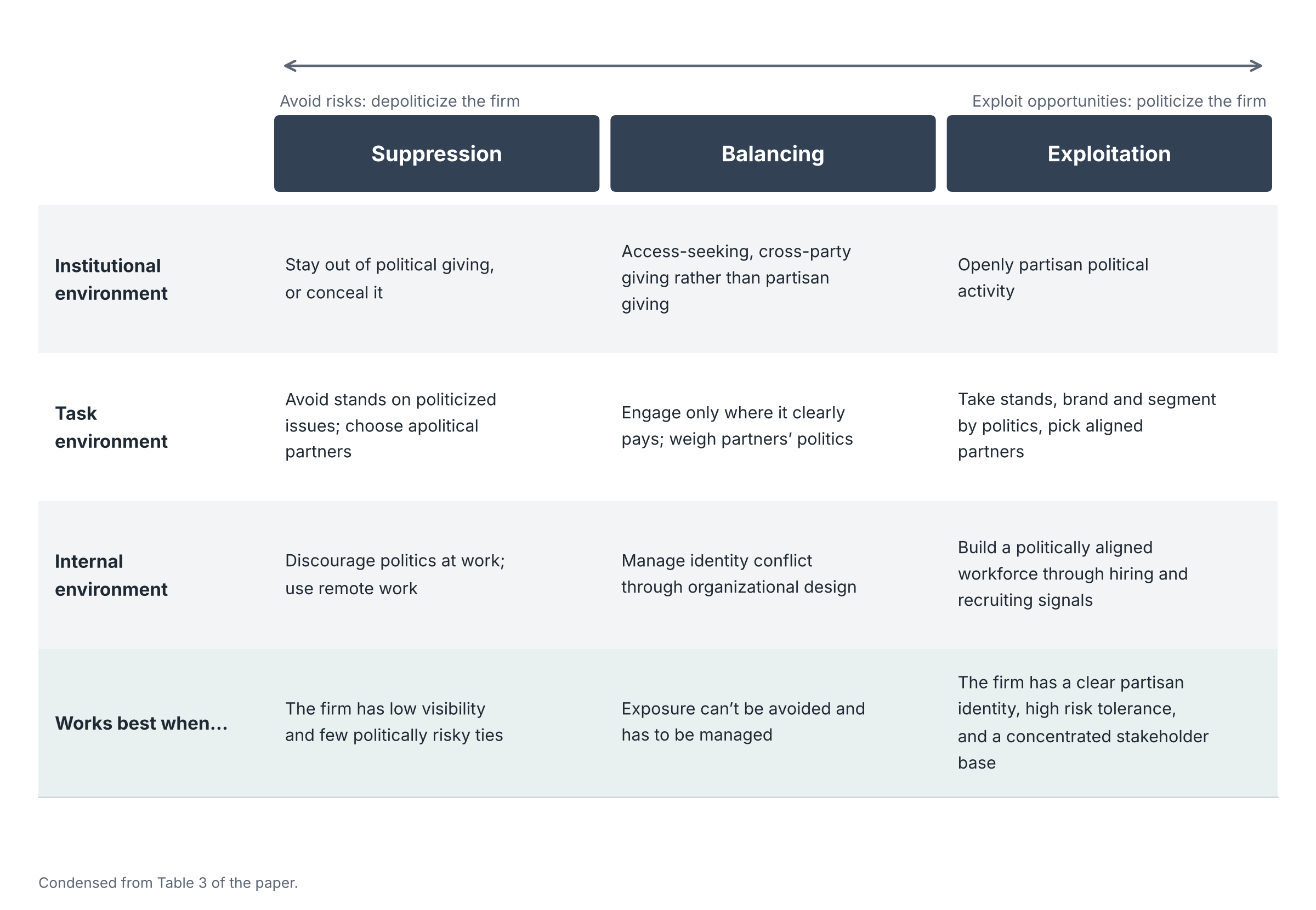
Firm strategies for managing affective polarization
Final Thoughts
None of this means a company can make polarization disappear. It can’t. But it can stop mistaking contempt for disagreement, work out which of the three doors it is most exposed through, and make deliberate choices about how to respond instead of having those choices made for it. And because the workplace is one of the few places left where people from opposing camps still work side by side, how firms handle all this may matter well beyond the firms themselves.
